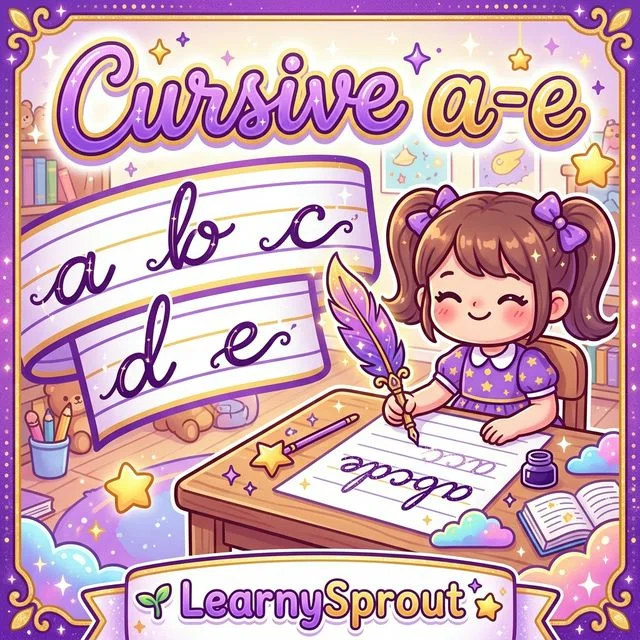
First Steps Into Cursive — Flowing a to e
Cursive writing begins here! This free printable cursive tracing worksheet introduces children aged 6+ to the connected lowercase forms of a, b, c, d, and e. Each letter features entry and exit strokes that enable connection to adjacent letters — the essence of cursive's flowing style. Dotted guidelines with directional arrows show exactly how each loop and curve should form, building confident cursive writers from the very first letter.
Why Cursive Still Matters
Research shows that cursive writing activates brain regions involved in reading, memory, and composition that print and typing do not. Children who learn cursive often show improved reading fluency and better information retention. The connected nature of cursive also builds writing speed — essential as academic demands increase. This worksheet introduces cursive gently, starting with five letters that share similar curved foundations.
Supporting Cursive Beginners
Make sure your child has solid print letter formation before starting cursive. The loop the loops pencil control worksheet is excellent cursive preparation. Practice entry strokes on a whiteboard before pencil-and-paper work. After this sheet, continue with cursive f-j. Our flashcards help maintain letter-sound knowledge alongside new cursive formation.
Explore Cursive on LearnySprout
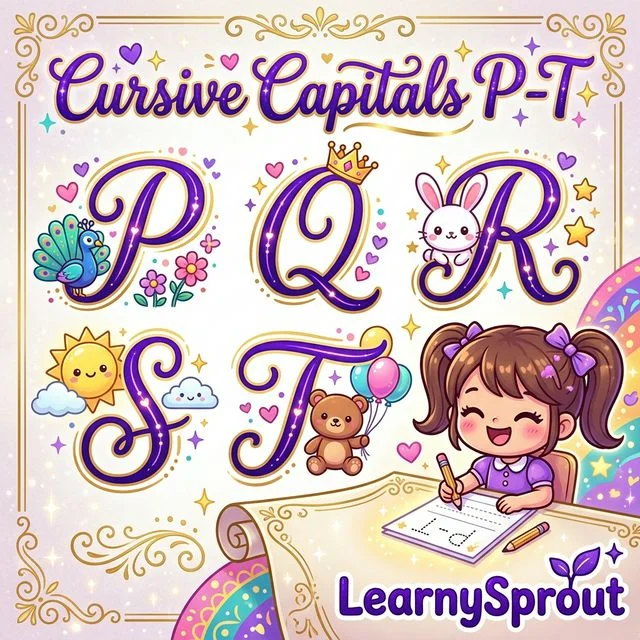
Progress through the series: f-j, k-o, p-t, u-z. LearnySprout's handwriting generator creates custom cursive practice. Pair with reading comprehension and coloring pages. Everything at LearnySprout is free!